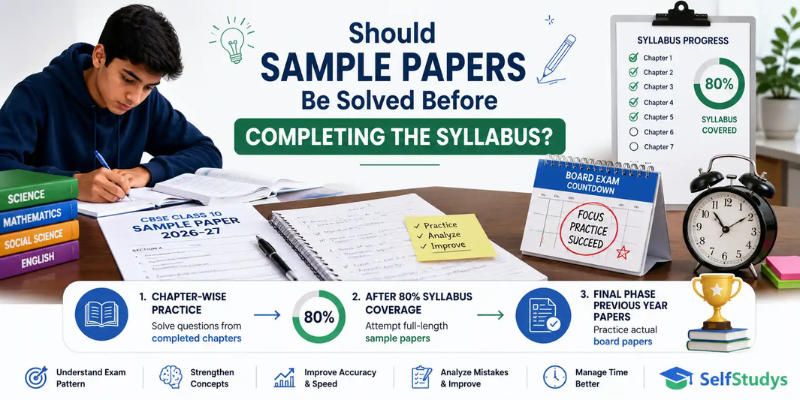
This is a common dilemma for Class 10 students preparing for their board exams. Once a portion of the syllabus has been completed and the exams start approaching, students often wonder whether they should begin solving sample papers immediately or wait until the entire syllabus is finished.
There are two common opinions. Some recommend avoiding sample papers until the syllabus is complete, while others suggest starting practice as soon as possible. Both approaches have some merit. The confusion mainly comes from treating all sample-paper practice in the same way.
The better approach is simple: start using sample-paper questions while studying individual chapters, but begin full-length sample papers after most of the syllabus has been covered.
Use Chapter-Wise Sample Questions Before Completing the Syllabus
You do not need to wait until the entire syllabus is complete to benefit from sample papers.
As you finish each chapter, practice the relevant questions from the CBSE Class 10 Sample Paper 2026-27. For example, after completing Chemical Reactions in Science, attempt sample-paper questions related to that topic.
This approach helps you:
- Check whether you have understood the chapter.
- Learn how the topic is tested in the examination.
- Apply concepts instead of simply memorizing them.
- Identify mistakes while there is still time to correct them.
- Reinforce your understanding through active practice.
At this stage, sample papers act more as a learning tool than a testing tool.
This is particularly useful with a competency-oriented examination pattern, where students need to apply concepts rather than rely only on direct recall.
Why Full-Length Papers Can Be Difficult Too Early
Consider a student who attempts a full sample paper after covering only half of the syllabus.
A significant portion of the paper may contain questions from chapters that the student has not studied yet. The resulting low score may not accurately represent the student’s actual preparation level.
It can also be discouraging because the student is being tested on topics they have not yet learned.
This is why full-length sample papers are more useful after a substantial portion of the syllabus has been completed.
The problem is therefore not early sample-paper practice itself, but using full-length papers at the wrong stage of preparation.
When Should You Start Full-Length Sample Papers?
A practical benchmark is to begin full-length sample papers after approximately 80% of the syllabus has been covered.
At this stage, most questions will come from topics you have already studied, making the score and analysis much more meaningful.
Before reaching this point, focus primarily on:
- Chapter-wise sample questions.
- Topic-specific practice.
- Reviewing mistakes.
- Understanding the marking scheme.
After reaching this point, gradually introduce full-length papers under timed conditions.
How to Use Sample Papers While the Syllabus Is Still in Progress
During the learning stage, follow a simple routine:
- Study the chapter using NCERT first.
- Solve sample-paper questions related to that chapter.
- Compare your answers with the solutions and marking scheme.
- Record the mistakes you make.
- Revise those mistakes before moving ahead.
Do not worry too much about your overall sample-paper score at this stage. The purpose is to understand the chapter and learn how examination questions are framed.
This allows you to build exam-oriented practice alongside your regular studies instead of postponing it until the end.
Move to Full Papers After Covering Most of the Syllabus
Once you have covered around 80% of the syllabus, change your approach.
Start attempting full-length sample papers under strict, timed conditions. This stage helps you develop:
- Time-management skills.
- Question-selection skills.
- Exam stamina.
- Familiarity with the complete paper.
- Accuracy under time pressure.
The objective also changes. Earlier, you were using sample questions to understand individual topics. Now, you are using full papers to evaluate how well you can combine those topics under examination conditions.
Add Previous Year Papers in the Final Phase
Once you become comfortable with full-length sample papers, include CBSE Previous Year Question Papers Class 10 during the final phase of preparation.
Sample papers help you practice the current examination format, while previous year papers provide exposure to actual questions and the difficulty levels seen in previous examinations.
A practical sequence is:
Chapter-wise sample questions → Full-length sample papers → Previous year question papers
This progression allows your practice to develop along with your preparation level.
An Illustrative Example
Imagine a Class 10 student preparing for Science throughout the academic year.
Instead of waiting until the entire syllabus is complete, she solves sample-paper questions from each chapter immediately after studying it. One week, she practices Electricity questions; the next week, she works on Genetics-related questions.
As she covers more of the syllabus, she becomes familiar with how different topics are tested.
Once she reaches approximately 80% syllabus completion, she begins attempting full-length sample papers under timed conditions. She analyzes each paper, identifies weak areas and works on them before attempting the next one.
Later, she adds previous year papers to test her preparation against actual board-paper questions.
This approach avoids both extremes: attempting full papers before being prepared and postponing all sample-paper practice until the last moment.
Common Mistakes to Avoid
- Attempting full-length papers before covering a substantial portion of the syllabus.
- Postponing all sample-paper practice until the syllabus is completely finished.
- Solving chapter-wise questions without checking the marking scheme.
- Focusing only on scores instead of analyzing mistakes.
- Delaying full-length timed practice until the final days.
- Leaving previous year papers until the very last moment.
- Using sample papers as a substitute for learning the actual syllabus.
Frequently Asked Questions
Should sample papers be solved before completing the syllabus?
Yes, but preferably in a chapter-wise format. Practice questions related to the chapters you have already studied and introduce full-length papers after covering most of the syllabus.
When should full-length sample papers be started?
A practical benchmark is after approximately 80% of the syllabus has been covered. The exact timing can depend on the student’s preparation level.
Can early sample-paper practice be discouraging?
It can be if you attempt full papers containing many chapters you have not studied. Chapter-wise practice of completed topics is more appropriate during the early stages.
How many full-length sample papers should be solved?
There is no fixed number. A limited number of full papers that are solved and analyzed carefully can be more useful than many papers completed superficially.
When should previous year papers be added?
They can be introduced during the final phase, after students have gained sufficient practice with full-length sample papers.
Should NCERT be studied before solving sample-paper questions?
Yes. Study the relevant NCERT chapter first and then use sample-paper questions to test your understanding and application of the concepts.
Conclusion
Should sample papers be solved before completing the syllabus? Yes—but in the right format.
Use chapter-wise sample questions alongside your studies, and move to full-length sample papers after covering approximately 80% of the syllabus. In the final phase, add previous year question papers to experience actual board-paper difficulty and question styles.
The key is not simply when you start solving sample papers, but how you use them at each stage of preparation. When introduced progressively, sample papers can become part of your learning process rather than something reserved only for last-minute revision.